
What it is
Version 1.0 of an emerging framework designed to help schools use the arrival of GenAI as an opportunity to strengthen students’ data literacy across subjects in upper secondary education. It is intentionally non-prescriptive—a flexible, cross-curricular “tool to think with” for professional dialogue, classroom reflection, and policy alignment.
Why it matters
The framework argues that GenAI changes what counts as data, how data are produced and interpreted, and how analytical processes are carried out—so data literacy must extend beyond technical skills to include critical evaluation, ethical awareness, and reflective human–AI collaboration.
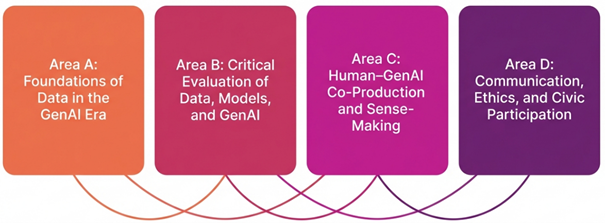
How it’s structured
Four interconnected areas:
Explore D2.3/ download pdf [LINK]
The framework helps identify the knowledge, skills and attitudes that teachers and students need to develop data literacy in the context of Generative AI, connecting data literacy with digital citizenship, democratic values, critical thinking, ethical awareness and responsible participation in society.
The framework was shaped by the diagnosis phase, including desk research, policy input from seven European Ministries of Education and a teacher survey.
Manuel Gentile, CNR-ITD – Italy
Q: If a school uses/will use the AI-DL Framework as intended, a cross-curricular ‘tool to think with’, what’s one concrete change you’d expect to see in classroom practice within a term, and why is that change the point of the framework?
A: The idea behind the framework stems from a view of generative AI not merely as a tool but as an opportunity to gain a deeper understanding of ourselves and the society in which we live.
With regard to data literacy, generative AI offers an opportunity to rethink the traditional and often narrow conception of this competence, which is predominantly understood as a set of technical skills focused on data analysis. Instead, the framework proposes a broader and more critical view of data literacy, which helps us understand how data, its representations and analytical processes influence the way we construct knowledge, form judgements, and express ideas and values.
From this perspective, the framework can help teachers reconsider the very concept of data and reflect on the role that pervasive tools now play in shaping the way we learn, interpret reality and act as citizens. The ultimate aim of the framework is therefore to contribute to the development of independent, responsible and critical-thinking students.
